
Most people misunderstand how currencies die.
They imagine panic, bank runs, and dramatic headlines. That did happen in Zimbabwe. But that is not how it usually happens. More often, currencies don’t collapse in a scream. They fade in a whisper.
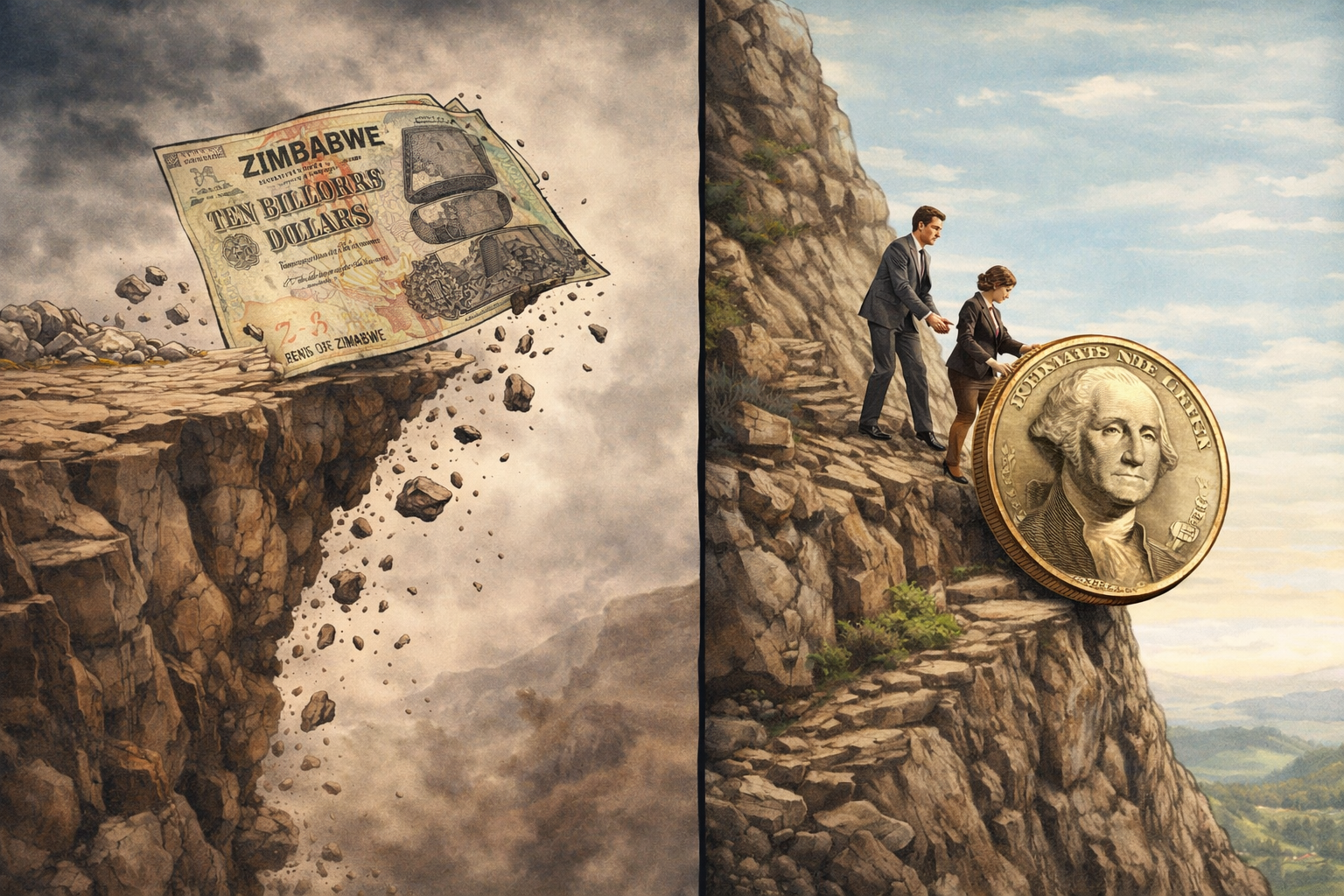
Zimbabwe shows us what a cliff fall looks like.
The United States shows us what a guided descent looks like.
The difference matters.
Zimbabwe’s Dollar Did Not Die From Inflation
It Died From Abandonment
The Zimbabwe dollar didn’t collapse because people complained or protested. It collapsed when people stopped needing it.
By the late 2000s, the currency issued by the Reserve Bank of Zimbabwe had broken its most basic promise: money no longer preserved effort, savings, or time.
When that happened, Zimbabweans adapted faster than policymakers.
They used:
- U.S. dollars
- South African rand
- barter systems
- airtime as money
- goods as stores of value
- diaspora remittances
The Zimbabwe dollar became a temporary pass-through, not a destination. Salaries were converted instantly. Prices were mentally quoted in other units. Trust no longer mattered because the system had been bypassed.
Hyperinflation was not the cause.
Hyperinflation was the symptom.
The currency didn’t fall because people lost faith.
It fell because people found alternatives.
That is what falling off a cliff looks like.
The U.S. Dollar Is Not Falling
It Is Being Quietly Walked Down
Now compare that to the U.S. dollar.
The dollar is not collapsing. There are no wheelbarrows of cash. There are no trillion-percent inflation prints. In fact, the dollar still dominates global trade, reserves, and finance.
But something important has changed.
Countries are no longer asking,
“Do we trust the dollar?”
They are asking,
“Do we need the dollar for this transaction at all?”
That shift is subtle. And it is dangerous.
The Real Crack Is Not Crypto
It Is Treasury Dependence
For decades, U.S. Treasuries were assumed to be infinitely liquid, infinitely trusted, and infinitely absorbable. That assumption broke in March 2020, when the Treasury market froze without intervention from the Federal Reserve.
Since then:
- Debt issuance has exploded
- Dealer balance sheets have not kept up
- Central banks are slowly reducing Treasury purchases
- The Fed is increasingly the buyer of last resort
This does not cause collapse.
It causes dependency.
And dependency slowly erodes confidence.
Weaponization Changed the Rules
When access to the dollar system becomes conditional, trust turns political.
Sanctions, asset freezes, and payment restrictions sent a clear message to the world: dollar access is not guaranteed. That message didn’t trigger rebellion. It triggered engineering.
Countries started building:
- local currency settlement systems
- bilateral trade agreements
- alternative payment rails
- commodity-backed settlement mechanisms
- digital currency infrastructure
Not to overthrow the dollar.
To route around it.
Zimbabwe Fell Because There Was No Buffer
The U.S. Has Buffers, But Not Immunity
Zimbabwe had:
- no reserve status
- no deep capital markets
- no external demand for its currency
- no ability to export inflation
The U.S. has all of those. That is why the process looks calm, bureaucratic, and slow instead of catastrophic.
Zimbabwe hit the cliff edge and fell.
America is being escorted down a long, winding path.
The outcome is not the same.
The mechanism is.
How Currencies Really Die
Currencies do not die when people lose trust.
They die when trust is no longer required.
When alternatives exist, usage quietly migrates:
- fewer trades priced in the currency
- fewer reserves held in it
- fewer transactions settled through its systems
- less centrality, more optionality
By the time leaders notice, the network has already moved.
That is what happened in Zimbabwe.
That is what is starting, slowly, globally.
The Final Warning
Zimbabwe was not a freak accident.
It was an early, concentrated case study.
The lesson is not that the U.S. dollar will “collapse like Zimbabwe.”
The lesson is worse:
The modern world no longer waits for permission to change money.
It builds exits instead.
And once exits exist, no currency stays dominant forever.
Leave a Reply