
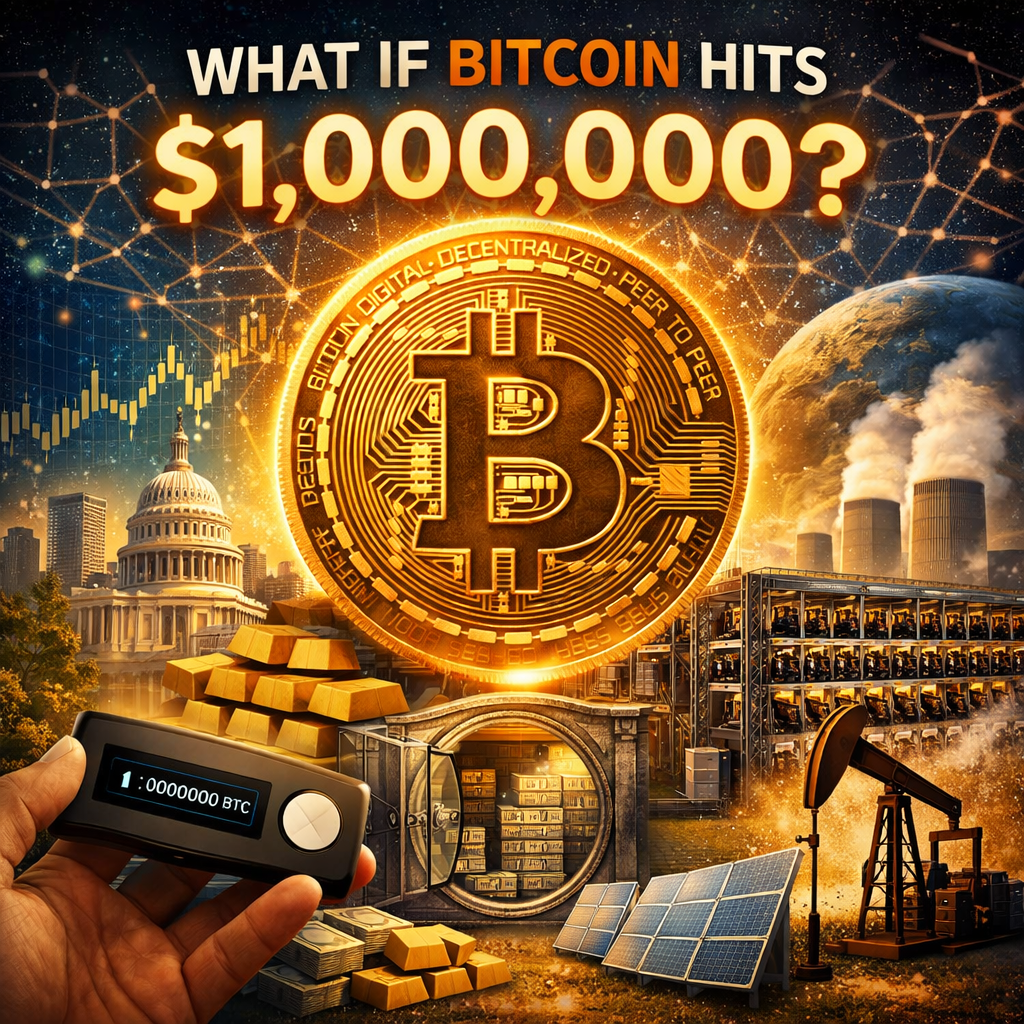
At first glance, a million-dollar Bitcoin sounds like a headline designed to break the internet. A meme number. Clickbait for late-night podcasts. But taken seriously, it is something else entirely. It is not a prediction so much as a stress test for how the world thinks about money, trust, and time.
If Bitcoin ever reaches $1 million per coin, the price itself will be the least interesting part of the story.
A $21 Trillion Signal
At $1 million per Bitcoin, the total network value sits around $21 trillion. That places it alongside the largest economic structures humans have ever built. Entire national economies. Gold as it is commonly measured. Not a startup anymore. Not an experiment. A core layer.
Markets do not allocate that kind of value casually. They do it when something proves durable under pressure.
This is the first clue. A million-dollar Bitcoin implies that global capital made a collective decision that Bitcoin was no longer optional.
Bitcoin Did Not Replace Money. It Measured It.
In this scenario, Bitcoin does not “win” because fiat currencies suddenly vanish. It wins because fiat keeps doing what it has always done: slowly losing purchasing power.
Inflation does not arrive with sirens. It arrives quietly. Prices drift upward. Savings buy less. The future gets more expensive than the past.
Bitcoin becomes the measuring stick. Not because it is perfect, but because it is fixed. When everything else moves, the thing that does not move becomes the reference point.
A million-dollar Bitcoin is less about Bitcoin going up and more about everything else being diluted.
From Trade to Treasury Asset
At that level, Bitcoin stops being a speculative trade and starts behaving like infrastructure.
Treasuries hold it. Pension funds allocate to it. Insurance balance sheets include it. Sovereign wealth funds treat it the way they treat gold or strategic commodities. Not for excitement. For resilience.
This is a subtle but profound shift. Bitcoin becomes collateral. Something you borrow against, not something you flip. Something you keep, not something you chase.
The question stops being “What’s the upside?” and becomes “What happens if we don’t hold any?”
A New Relationship With Time
A million-dollar Bitcoin suggests a cultural shift in how people think about saving.
For decades, the dominant mindset has been yield-obsessed. If your money is not working, it is wasting away. Risk is normalized. Complexity is encouraged. Stability is treated as laziness.
Bitcoin flips this logic. It rewards patience, not activity. Its value proposition is brutally simple: scarcity plus time.
At scale, this changes behavior. People stop asking how fast their money can grow and start asking whether it will survive intact across decades. Bitcoin is boring by design, and boring has a long life expectancy.
Unequal, Uncomfortable, and Real
There is no avoiding this part. A million-dollar Bitcoin means ownership is uneven.
Most people will not own whole coins. They will own fractions. Satoshis become the everyday unit. Early holders look less like lucky gamblers and more like people who recognized a structural shift early.
This is uncomfortable, but it is also honest. Every new monetary system creates winners based on timing and conviction. Bitcoin is not an exception. It is simply transparent about it.
Energy, Not Just Finance
At that valuation, Bitcoin mining stops being a niche industry and becomes a serious energy customer.
Mining gravitates toward what the grid cannot easily use: stranded hydro, excess nuclear capacity, flared gas, geothermal. Bitcoin becomes a buyer of last resort for energy that would otherwise be wasted.
This is where things get interesting. Finance meets physics. Monetary policy meets thermodynamics. Bitcoin does not just store value. It reshapes incentives around how energy is produced and consumed.
Politics After the Debate Ends
No government “bans” a $21 trillion neutral network.
At that point, the conversation changes tone. Regulation replaces resistance. Integration replaces hostility. Taxation replaces dismissal.
Bitcoin at $1 million is not rebellious. It is boring, systemic, and quietly embedded. Governments may not love it, but they plan around it.
The Quiet Part
Here is the paradox.
If Bitcoin ever reaches $1 million, it probably will not feel euphoric. There will be no universal celebration. No victory lap. It will feel obvious in hindsight.
Like realizing gravity was always there.
The real story will not be the price on the screen, but the moment the world stops debating whether Bitcoin matters and starts debating who has access to it, who controls custody, and who gets left behind.
At that point, the question will no longer be “What if Bitcoin hits $1 million?”
It will be “What did it cost us to ignore it for so long?”
Leave a Reply