

Elon Musk recently suggested that humanity faces only two futures: collapse, or an era of AI abundance where money no longer matters.
It’s a striking idea.
It’s also a false binary.
There is a third path.
Not collapse.
Not submission.
Exit by design.
The Real Question Is Not AI vs Humans
Most debates about artificial intelligence are framed as a competition: machines versus people, automation versus relevance, algorithms versus work. That framing is dramatic, but it misses the deeper issue.
The real divide is ownership versus dependency.
Who owns the land.
Who owns the energy.
Who owns the data.
Who owns the infrastructure rails.
In an AI-accelerated world, anything you don’t own will eventually be automated around you. Jobs, services, logistics, and even culture can be optimized away if they exist only as rented access. Cities are not immune to this dynamic. In fact, they are at its center.
If you don’t own the rails, you don’t choose the destination. You just ride along.
The Third Path: Exit by Design
“Exit” does not mean abandoning society, retreating to the woods, or rejecting technology. It means opting out of systems where participation requires permanent dependency.
Exit by design is about structural choice.
It means building environments where people can live, work, compete, and belong without being reduced to tenants of opaque platforms. It means designing systems where technology serves citizens, not the other way around.
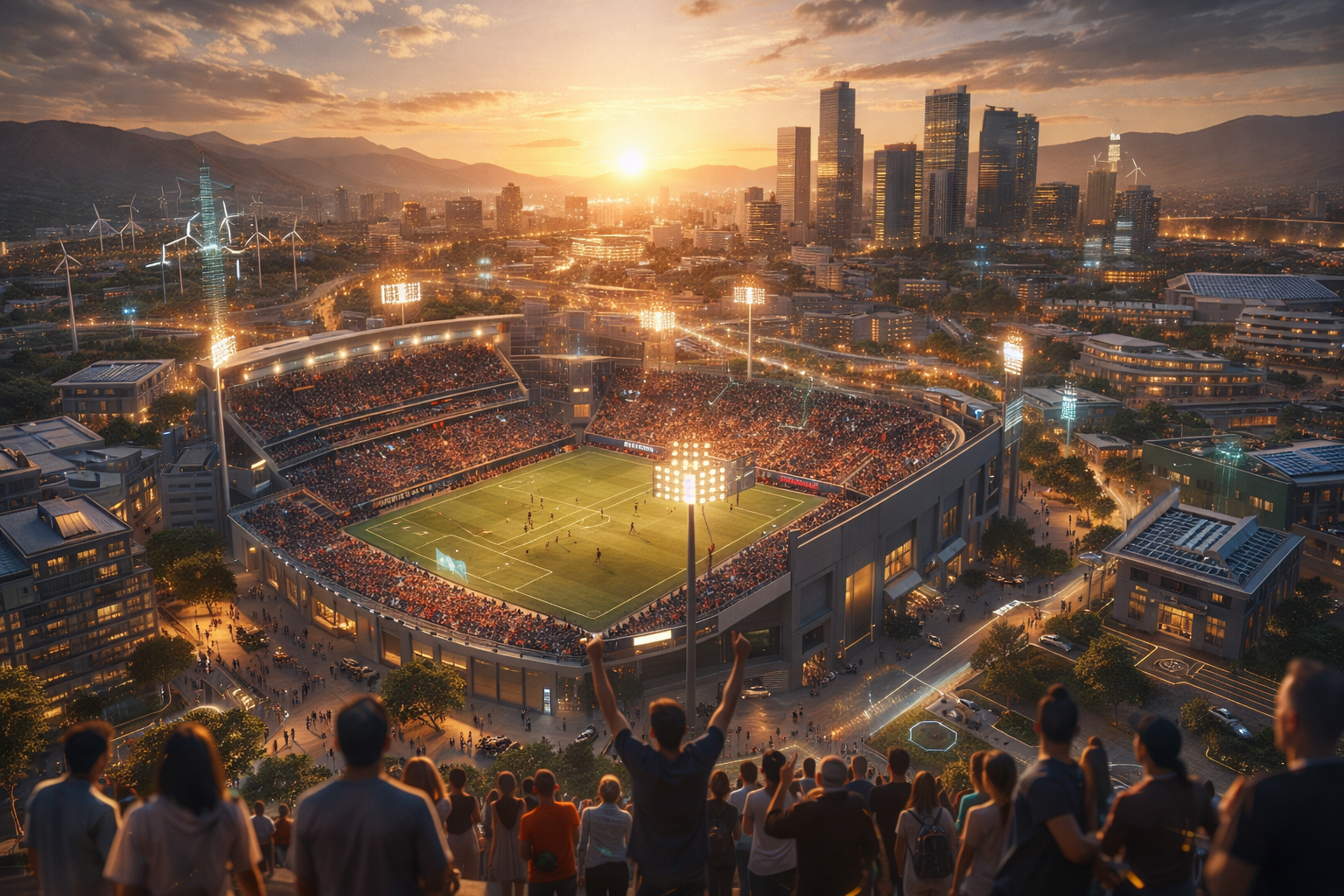
This is the foundation of Sports Cities and CityOS.
Cities Are the Unit of the Future
Nation-states move slowly and are constrained by legacy politics. Platforms move fast but answer to shareholders, not communities. Corporations optimize for extraction, not continuity.
Cities are different.
Cities sit at the intersection of land, labor, culture, and capital. They are where daily life actually happens. Housing, transportation, energy, education, and recreation all converge at the city level. That makes cities the most powerful lever for shaping the future.
The next era will not be decided by flags or apps.
It will be decided by how cities are designed.
What CityOS Really Is
CityOS is not a piece of software you download. It is an operating philosophy for modern cities.
A city built on CityOS principles has a few defining characteristics:
Rules are transparent and programmable, not discretionary or opaque.
Ownership is provable and verifiable, not hidden behind intermediaries.
Infrastructure is automated where it makes sense, but governance remains human.
AI runs logistics, energy optimization, traffic, and services as a public utility, not as a private god.
Citizens own the upside of their city instead of being rented to by extractive systems.
The goal is not to remove humans from decision-making. The goal is to remove friction, corruption, and opacity from systems humans rely on every day.
Efficiency serves people. People do not serve efficiency.
Why Sports Are the Human Anchor
Even a perfectly designed city can fail if it lacks a human center of gravity.
This is where sports matter in a way technologists often underestimate.
Sports are not just entertainment. They are one of the last large-scale arenas where humans still compete publicly against one another, not machines. They create ritual, identity, and belonging. They demand effort, courage, and discipline in ways no algorithm can simulate.
You can’t automate grit.
You can’t outsource spirit.
You can’t tokenize heart.
In cities where sports matter, people still gather physically. They still share wins and losses. They still test themselves. That human energy anchors everything else.
What a Sports City Actually Does
A Sports City is not simply a stadium surrounded by parking.
It is a different economic and social model.
In a Sports City:
- Land becomes equity rather than dead capital.
- Fans become stakeholders instead of passive consumers.
- Infrastructure becomes shared capital instead of extractive rent.
- Participation replaces pure consumption.
The stadium is not a monument. It is an engine. It activates real estate, community, youth development, tourism, and local enterprise. It turns culture into durable infrastructure.
Sports Cities are, by design, anti-tenant cities.
They give people a reason to show up, a place to belong, and a stake in what is being built.
Sports Cities + CityOS: The Complete Loop
CityOS provides the rules, transparency, and automation that make a modern city efficient and fair. Sports Cities provide the human gravity that keeps that city alive.
Together, they form a complete loop:
- Technology handles complexity.
- Humans retain agency.
- Ownership stays local and provable.
- Culture remains physical and shared.
This is not nostalgia. It is architecture.
This Is Not Anti-Technology. It’s Pro-Human
None of this rejects AI. In fact, it assumes AI will be everywhere.
The danger is not abundance.
The danger is abundance without ownership.
When people don’t own the systems they depend on, efficiency becomes control. Convenience becomes dependency. And freedom quietly erodes without anyone voting on it.
Sports Cities and CityOS are about widening human agency, not slowing progress. They are about making sure technology amplifies people instead of replacing their role in their own communities.
The Builders Will Be Rewarded
History does not reward defenders of old systems. It rewards those who build new ones that solve real problems.
Those who own the rails decide the future.
Those who don’t rent their lives.
In the next era, freedom will not be automatic.
It will be opt-in.
Sovereignty will not be inherited.
It will be designed.
Sports Cities and CityOS are not predictions.
They are choices already being made.
The only real question left is not whether this future arrives.
It’s who gets to own it.
Leave a Reply