
A brutally honest way to measure whether you are moving forward or quietly falling behind.
There is a simple question that cuts through inflation charts, job titles, government reassurances, and motivational LinkedIn posts.
How much gold does my salary buy?
Not how much I earn.
Not what my payslip says.
Not what the CPI claims.
Gold is the measuring stick that does not care about excuses.
I learned this lesson once already, the hard way, in Zimbabwe between 2004 and 2008. Back then, salaries arrived on time while reality slipped away. You could be paid in the morning and be poorer by lunchtime. People who understood the game stopped counting money and started counting assets.
Years later, living and working in North America, I asked myself the same question again. This time, slowly. Quietly. With spreadsheets instead of panic.
The answer was unsettling.
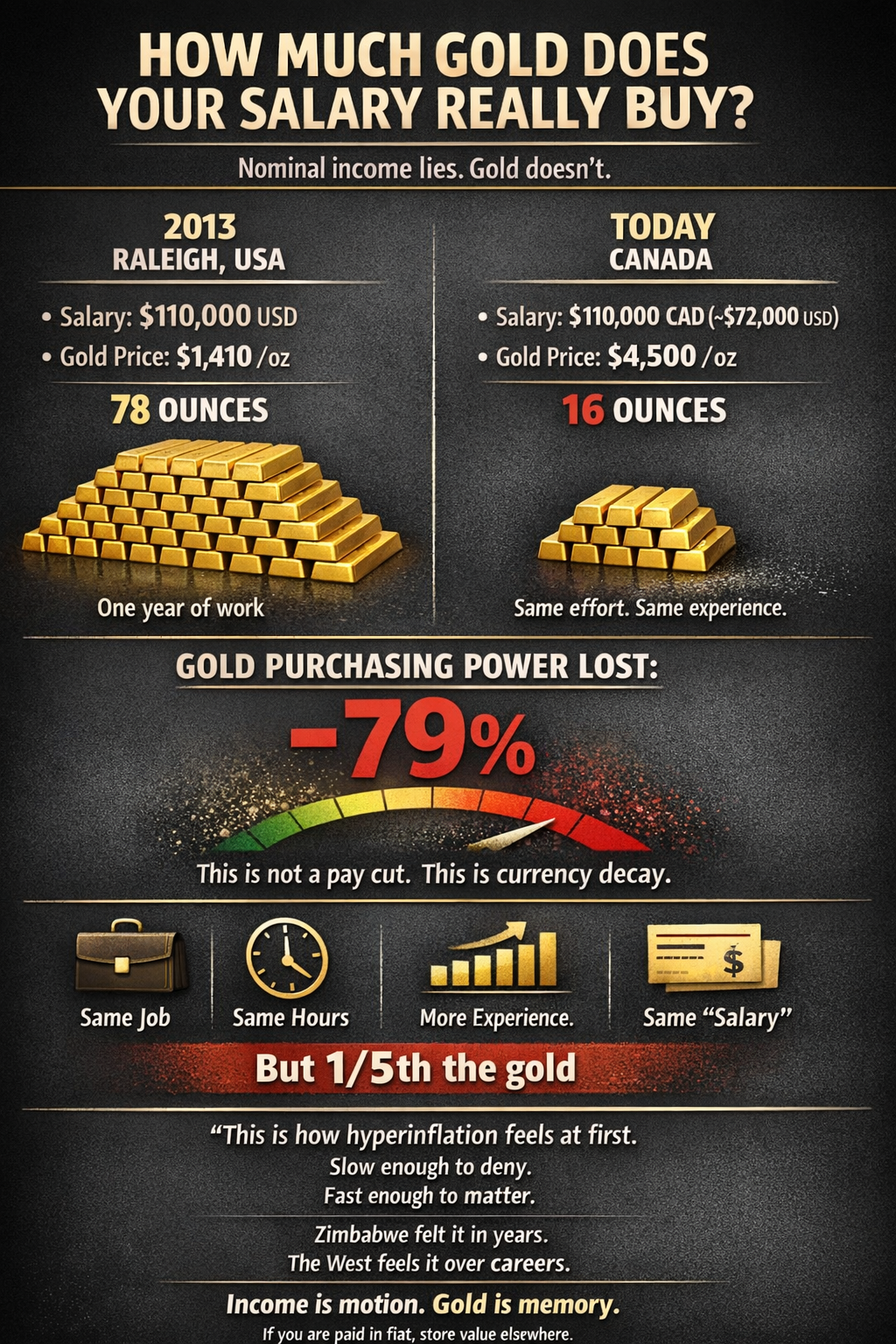
In 2013, earning $110,000 USD in Raleigh, North Carolina, gold was around $1,410 per ounce. That salary could buy roughly 78 ounces of gold.
Fast forward to today.
I now earn about $110,000 CAD, roughly $72,000 USD. Gold sits near $4,500 per ounce. That same year of labor buys 16 ounces of gold.
Same effort.
Same experience.
Same ambition.
One fifth the gold.
This is not a story about personal failure. It is a story about the unit of account failing quietly while everyone nods politely.
Gold did not “go up.” Gold does not have earnings calls or stimulus packages. Gold simply remembers. Currencies forget. Salaries lag. Assets adjust.
This is why people feel like they are running faster and getting nowhere. Promotions feel hollow. Raises feel insulting. Savings feel like sand slipping through fingers. You are not imagining it. You are being paid in a melting ruler.
What makes this realization powerful is not nostalgia for gold or fear of collapse. It is clarity.
Gold is not magic. It is a truth serum. When you price your labor in gold, illusions dissolve. You see instantly whether your work is compounding or being diluted.
This is why every hyperinflation story sounds the same across history. People who rely on wages suffer. People who hold scarce things survive. The timeline changes. The accent changes. The mechanism does not.
Zimbabwe compressed the lesson into four years. North America stretches it across forty. The pain is quieter, but the math is identical.
The real takeaway is not to quit your job or bury coins in your backyard. It is to separate income from wealth in your thinking.
Income is motion.
Wealth is memory.
If you are paid in fiat, you must store value elsewhere. If you measure success only in nominal currency, you will feel richer while becoming poorer. If you never ask what your salary buys in real, scarce terms, you will always be surprised later.
So try the exercise yourself. Ignore headlines. Ignore opinions. Take your salary and divide it by something that cannot be printed.
Gold. Land. Energy. Productive assets.
The answer may be uncomfortable. Discomfort is the beginning of strategy.
Money moves.
Gold remembers.
And once you see the difference, you cannot unsee it.
Leave a Reply