
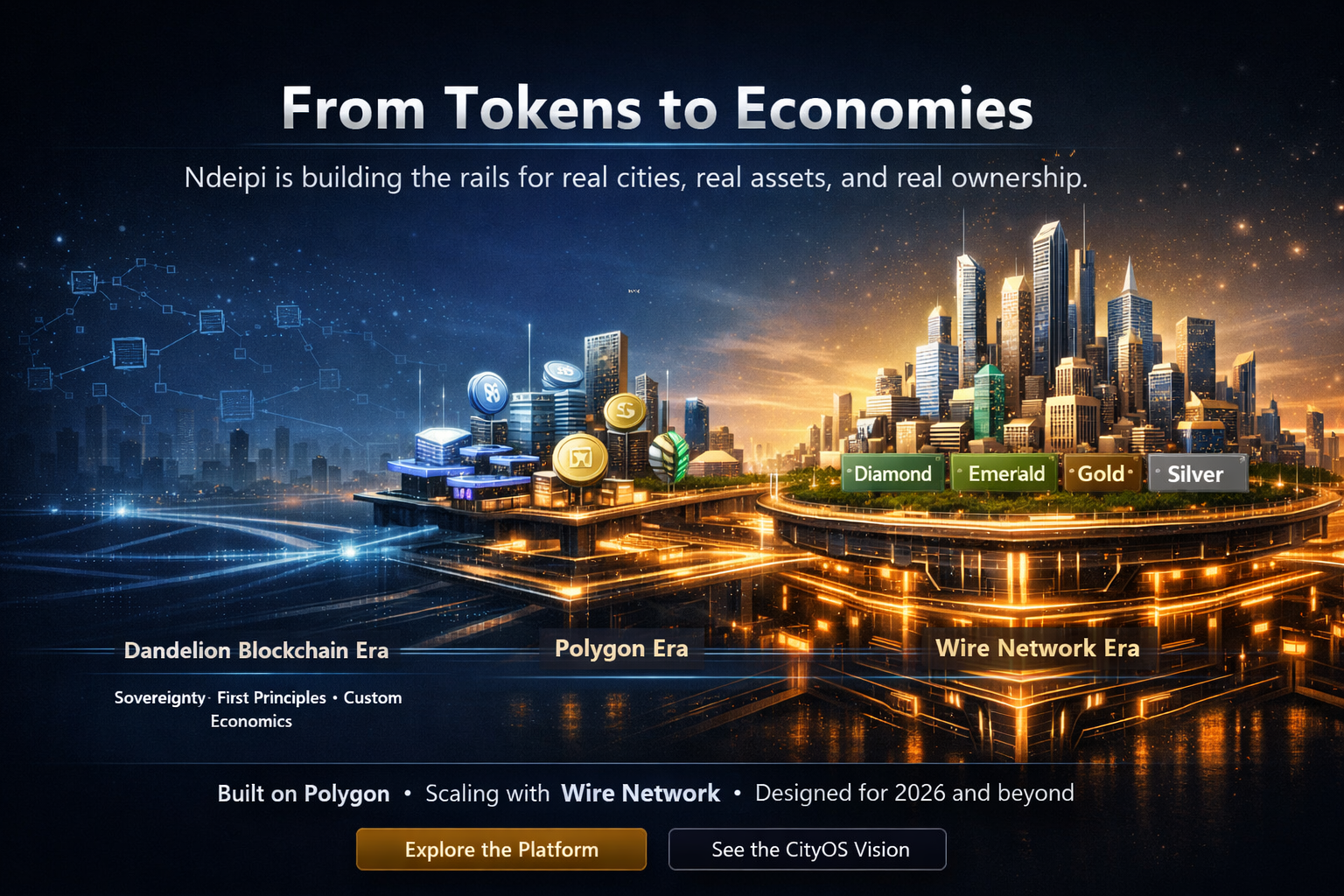
There is a myth in crypto that great systems are born from sudden inspiration. In reality, durable systems are built through iteration, friction, and pattern recognition. Ndeipi’s journey across blockchains is not a story of indecision. It is a story of learning where real value actually settles.
From the beginning, the vision was never just to launch another token. The vision was to build living economies. Cities. Sports infrastructure. Real world assets. Systems where people do not merely transact, but participate and own.
That kind of ambition forces hard architectural choices.
The Dandelion Phase: Philosophy First
The early collaboration with Dandelion Blockchain was driven by alignment on sovereignty, custom economics, and first principles. On paper, it made sense. Dandelion represented independence and ideological purity.
But real systems are not judged by philosophy alone. They are judged by execution velocity.
As development progressed, friction emerged. Not malicious. Not incompetent. Just structural drag. When your mission involves cities, capital markets, sports franchises, and regulated assets, momentum is oxygen. Without it, even good ideas suffocate.
So the decision was made to exit cleanly.
Polygon as Scaffolding, Not Destiny
The migration to Polygon was not a pivot of belief. It was a pragmatic move to keep building.
Polygon provided liquidity, tooling, developer access, and reliability. It allowed Ndeipi to continue constructing the real work: tokenization frameworks, RWA structures, financial rails, and city-level economic models.
But Polygon was never framed internally as the final home.
It was scaffolding.
Temporary infrastructure that let the builders keep building while the long-term strategy matured.
The Original Fork in the Road
From day one, there were always three strategic paths under consideration:
Build an independent blockchain from scratch
Remain modular on an existing high-liquidity chain
Partner with a network that wanted ecosystem growth, not just transaction fees
The third option is where things became interesting.
At a certain scale, the question changes. It stops being “where do we deploy” and becomes “who owns the rails.”
History is very clear on this point. The platforms that endure are not the loudest apps. They are the rails beneath them.
Enter Wire Network
Wire Network did not enter the picture as hype or coincidence. It emerged naturally once the Ndeipi ecosystem reached sufficient maturity.
Wire is not positioning itself as just another chain. It is positioning itself as an ecosystem partner. A network that understands that real value comes from real usage, real economies, and real transaction flow.
This matters.
Ndeipi is not chasing speculative volume. It is architecting cities, districts, and economic zones where transactions are inevitable. Payments. Ownership transfers. Tokenized assets. Governance actions.
When those transactions happen, value accrues to the rails.
Wire understands that dynamic. And critically, it is building for where the market is going in 2026 and beyond, not where it was in the last cycle.
Founder-Led, Not Crowd-Led
This decision was not outsourced. It was not suggested by influencers. It was not driven by social consensus.
It was a founder-led call, informed by lived experience across multiple chains and a clear-eyed view of where durable value accumulates.
Ndeipi had already proven it could migrate. Already proven it could build. Already proven it could operate cross-chain.
That leverage matters. It turns choice into strategy.
From Tokens to Economies
The move toward Wire is not about abandoning Polygon or any other network. Cross-chain remains part of the architecture.
The shift is about elevation.
From deploying on rails to co-creating rails.
From being a guest to being a utility.
From applications to infrastructure.
Polygon helped Ndeipi build.
Wire helps Ndeipi scale.
And the long-term vision remains unchanged: real economies, owned by real people, running on rails designed to last.
In the end, this was never about chains.
It was about choosing the right foundation for a future that is already being built.
Leave a Reply