
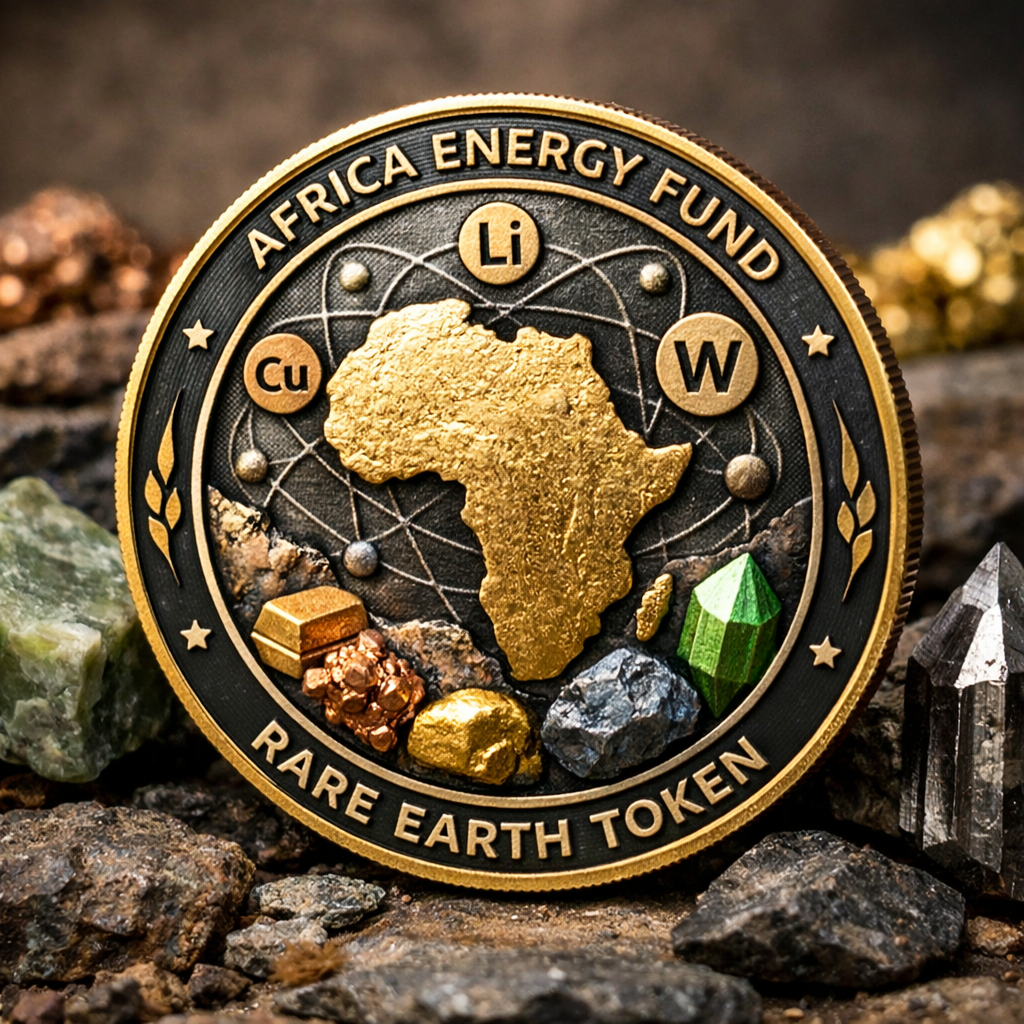
Hard assets. Strategic minerals. Tokenized access to the future.
Africa is entering a minerals renaissance, and Africa Energy Fund is placing a decisive marker in the ground with the AEF Zimbabwe Rare Earth Token.
This token represents exposure to one of the most compelling multi-commodity mineral prospects in Southern Africa, located in Hurungwe, Zimbabwe.
Location and Scale
Hurungwe sits in a geologically rich region with proven mineralization and growing access to regional infrastructure and export corridors. The concession spans 3,750 hectares, offering both scale and geological diversity, a critical ingredient for long-life mining operations.
Sampling to date has focused on grab samples, manually collected from surface outcrops and rock fragments. While early-stage, the results are notable for both grade and elemental diversity.
Laboratory Results Snapshot
Across multiple accredited testing methods (XRF, wet chemistry, Niton XRF, and fire assay), the site shows a rare concentration of energy-transition and industrial metals.
Copper appears at 4.25–4.71%, levels that immediately place the project on the radar for serious copper development. In a world electrifying everything from vehicles to data centers, copper remains non-negotiable.
Lithium oxide registers at 3.143% Li₂O, a strong indication of battery-grade lithium potential. This positions the asset directly in the supply chain of EVs, grid storage, and AI infrastructure.
Tungsten stands out at 9.92%, an industrial metal critical for aerospace, defense, cutting tools, and high-temperature applications. Tungsten supply is geopolitically sensitive, making diversified sources extremely valuable.
Gold averages 1.22 g/t, not headline-grabbing on its own, but meaningful when paired with polymetallic mineralization. Antimony at 2.77% strengthens this story, as it is frequently associated with gold systems and is itself a strategic metal.
Rare and strategic elements add further depth: Gallium at 3.46%, Niobium at 3.35%, Uranium at 0.13%, along with cobalt, tin, and titanium, collectively elevate the project from a single-commodity play to a true critical-minerals basket.
Why This Matters Now
Global capital is rotating away from abstract growth stories and back toward hard assets with geopolitical relevance. Electrification, defense re-industrialization, AI compute, and energy security all depend on the exact metals present at Hurungwe.
Zimbabwe’s improving capital markets, USD-based trading environment, and proximity to regional export corridors amplify the value of discoveries like this. The minerals are not stranded. They are increasingly reachable.
The Token Thesis
The AEF Zimbabwe Rare Earth Token is designed to give structured, transparent exposure to this mineral portfolio.
Instead of betting on a single metal, token holders gain exposure to a polymetallic system aligned with global demand trends: copper for power, lithium for storage, tungsten for industry, gold for monetary stability, and rare elements for advanced manufacturing.
This is not speculation detached from geology. It is tokenization anchored to laboratory data, land, and real rock.
A Signal, Not a Footnote
Africa Energy Fund’s announcement of its largest mining deal in Zimbabwe is intentional. It signals confidence not only in the asset, but in Zimbabwe’s re-emergence as a serious destination for disciplined, long-term mining capital.
The next decade will not be defined by who tells the best story. It will be defined by who controls the materials that power the world.
Zimbabwe has them.
AEF is structuring them.
The token is the gateway.
Leave a Reply