
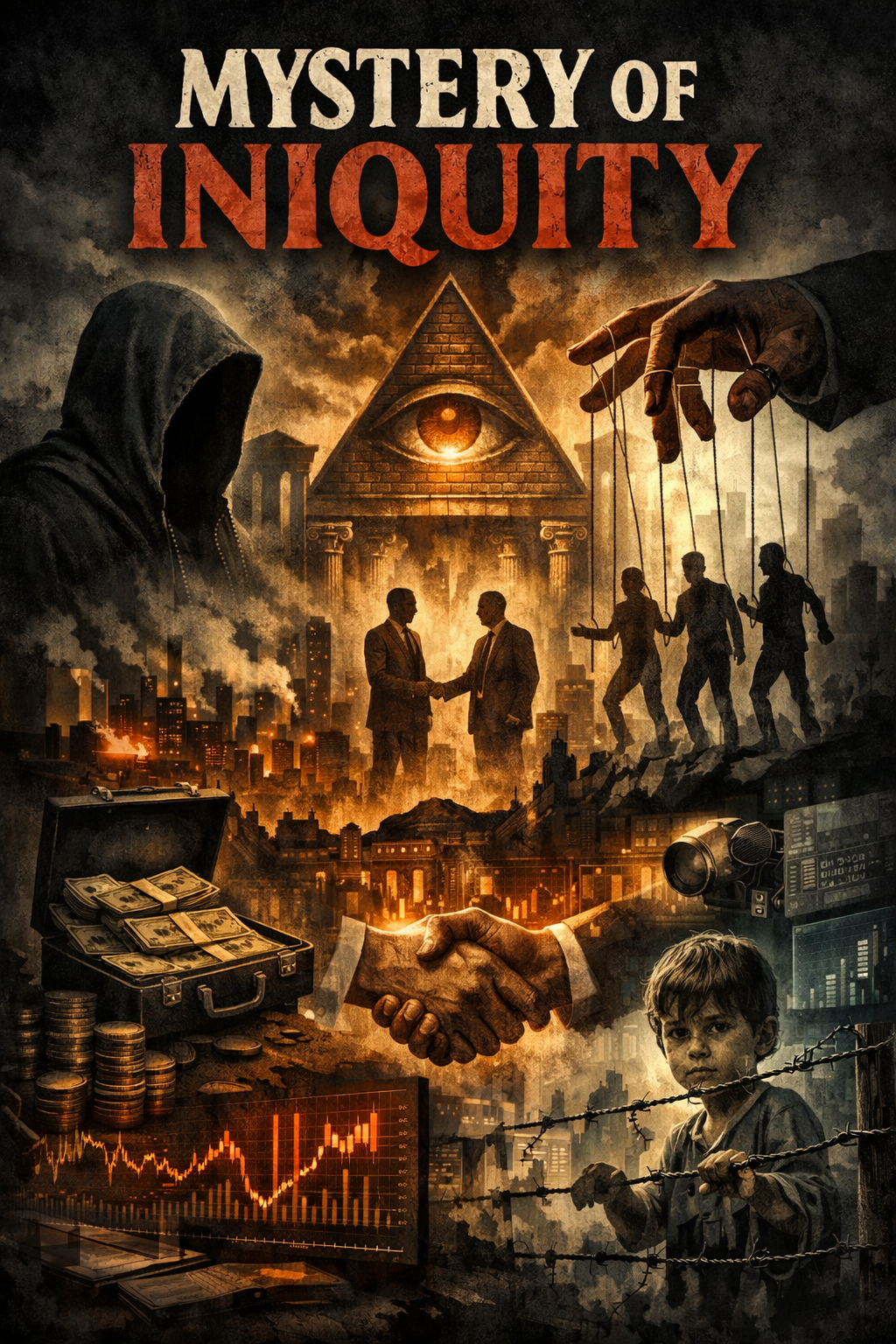
On hidden systems, financial disorder, and the architecture of what replaces them.
For the mystery of iniquity doth already work: only he who now letteth will let, until he be taken out of the way.
2 Thessalonians 2:7 — King James Version
I. The Hidden Engine
Paul did not write about chaos. He wrote about something far more dangerous — organized disorder. The Greek word he used was anomia: not lawlessness in the sense of anarchy, but the deliberate absence of governing principle. A system that writes its own rules, then calls the result natural order.
That is the mystery. Not that evil exists. But that it organizes itself — quietly, systematically, over generations — until it becomes the background hum of civilizational life. Until no one asks who built it or who it serves.
It is already working, Paul said. Present tense. Not a future threat. A present condition. The iniquity is not coming. It is already running in the background.
“Evil isn’t always loud. The most consequential disorder wears the face of inevitability — it doesn’t announce itself, it simply becomes the water everyone swims in.”
— Dr. Tyrone Moodley
II. What It Actually Looks Like
Strip the theology for a moment and consider the structure. The Mystery of Iniquity describes a system with three defining features:
- It is already operational — not waiting for a trigger event to begin
- It works beneath the surface of what appears legitimate
- It sustains itself through the very institutions trusted to restrain it
Now ask: does that pattern appear anywhere in the world you inhabit?
Bretton Woods did not collapse — it was quietly replaced by a dollar float that transferred seigniorage benefits to one nation while exporting inflation to the rest of the world. The adjustment wasn’t announced. There was no press release declaring that the rules had changed. The mystery operated as mysteries do — through the gap between what is said and what is structured.
SWIFT, correspondent banking, de-risking policies — none of these were introduced as mechanisms of exclusion. They emerged, became load-bearing infrastructure, then became invisible. And invisibility is precisely the point. A system you can see, you can contest. A system that has become the assumed background of reality is nearly impossible to challenge — because challenging it sounds like challenging reality itself.
III. Africa as Case Study
I grew up in Zimbabwe during hyperinflation. I was a money changer before I was anything else professionally. I watched a currency become worthless — not because of natural disaster, not because of drought or plague — but because of the deliberate architecture of extraction dressed in the language of fiscal policy.
Zambia holds some of the most significant copper reserves on earth. It has held them for generations. The question has never been whether the wealth was there. The question was always: who controls the instruments that measure, certify, and price it?
When you don’t control the measurement system, you don’t control the asset. When you don’t control the financial rails, the asset is perpetually undervalued in negotiation. The wealth exists. The legibility — the formal, globally recognized inscription of that wealth into instruments that capital markets will recognize — that is what has been systematically withheld.
That is the mystery of iniquity at continental scale. Not a conspiracy of mustache-twirling villains. A structural arrangement that benefits from the illegibility of African productive assets, reproduced across decades through the mundane operations of commodity pricing, royalty agreements, and correspondent banking access.
“Making something legible to capital is the first act of sovereignty over it. The credit register, the land survey, the tokenized asset — these are not financial instruments. They are acts of inscription. They are how a people say: this exists, it is ours, and the world must now account for it.”
— Dr. Tyrone Moodley
IV. The Blockchain Thesis
When Satoshi Nakamoto published the Bitcoin whitepaper in 2008, the immediate context was the financial crisis. But the deeper provocation was older than that. The problem wasn’t that banks had made bad bets. The problem was that the rules of the game — who could participate, on what terms, under whose custody — had never been transparent in the first place.
Blockchain, when built with genuine intentionality, is an anti-mystery protocol. It does not eliminate human corruption. It makes the rules of value transfer readable, auditable, and contestable. Every transaction recorded on a public ledger is a small act of forced legibility. You cannot quietly change the terms of settlement at 2am in a back office. The ledger remembers.
But the tool is only as honest as the intention behind it. Blockchain can also carry the mystery of iniquity forward — in the form of opaque governance tokens, concentrated ownership masquerading as decentralization, and protocols designed to appear open while directing value to their founders. The technology is neutral. The architecture is not.
The design question
This is why the governance layer matters as much as the technology layer. A hard cap on total token supply is not just a tokenomics decision — it is a statement about the relationship between the protocol and the communities it serves. Cooperative ownership structures embedded in the protocol are not just business model choices — they are answers to the question of who the system is for.
The Mystery of Iniquity operates through the gap between stated purpose and structural reality. The antidote is not better marketing. It is architecture that makes the gap impossible to maintain — systems where the rules are inscribed in the protocol, not stored in someone’s discretion.
V. The Restrainer
Paul’s verse continues: “only he who now restrains it will do so, until he is taken out of the way.”
Theologians have debated for millennia who or what the restrainer is. For our purposes, the structural point is sufficient: something holds the mystery in check. And when that restraining force is absent or corrupted, the disorder becomes visible and dominant.
In the architecture of transparent financial systems, the restrainer is governance. Not governance in the sense of regulators who can be captured — but governance embedded so deeply in the protocol that it cannot be removed without consensus from the community it serves. Hard caps. Supermajority requirements. Non-negotiable infrastructure protections that require the explicit will of stakeholders to alter.
The Foundation structure, the Public Benefit Corporation amendment, the cooperative ownership layer — these are not bureaucratic formalities. They are the restraining architecture. They are what prevents a system built on transparency from quietly becoming another iteration of the mystery it was designed to replace.
VI. The Honest Reckoning
There is a harder question underneath all of this, and it deserves to be asked directly.
Anyone building in the intersection of traditional capital markets and alternative financial infrastructure is — by necessity — in contact with the system they seek to replace. The institutional closes, the exchange listings, the correspondent banking relationships: these are points of interface with structures that carry their own histories of extraction. You cannot build without that contact. The question is whether the contact absorbs you.
The mystery of iniquity does not only operate through obvious villains. It also operates through good people who make incremental compromises — each one reasonable in isolation, each one moving the structure slightly further from its founding intention. The governance architecture exists to protect against that drift. But architecture requires stewardship. And stewardship requires that someone — consistently, across time and through pressure — asks whether what is being built is still what was intended.
That is the real legacy question. Not whether the technology works. Not whether the capital closes. But whether, twenty years from now, the communities this infrastructure was built to serve are actually freer — actually holding more sovereignty over their productive assets, their currencies, their economic futures — than they were before.
Are you operating inside that system — or designing the one that replaces it?
The answer isn’t binary. But the question must be kept alive — held at the center of every architectural decision, every governance compromise, every institutional relationship. The moment it stops being asked is the moment the mystery begins to work.
Written by Dr. Tyrone Moodley
Founder & CEO, Ndeipi Inc. | Ambassador, State of the African Diaspora
Leave a Reply